

Depression DSM-5 criteria define depressive disorders by specific symptom counts, duration and functional impact; persistent depressive disorder (PDD, formerly dysthymia) is a chronic, lower-grade but long-lasting depression lasting ≥2 years, distinguished by duration and course rather than only symptom severity.
Understanding Depression According to DSM-5
Answer: DSM-5 defines depressive disorders by a core set of symptoms (depressed mood, anhedonia, weight/sleep/psychomotor changes, fatigue, guilt/worthlessness, concentration problems, suicidal ideation) with specific criteria for symptom number, duration and functional impairment required for clinical diagnosis.
DSM-5: The Diagnostic and Statistical Manual of Mental Disorders, Fifth Edition, is the American Psychiatric Association’s classification and diagnostic tool for mental disorders.
DSM-5 (published by the American Psychiatric Association) groups depressive disorders and provides operational criteria clinicians use to make reliable diagnoses; the manual emphasizes symptom clusters, minimum durations, and rule-outs for medical/medication causes and other psychiatric disorders. For authoritative guidance, see the APA manual.
DSM-5’s diagnostic framework separates episodic major depressive disorder (MDD) from chronic presentations such as persistent depressive disorder (PDD). Clinicians combine clinical interview, collateral history and standardized rating scales (e.g., PHQ-9, HAM-D) to confirm criteria.

Clinical assessment commonly uses validated tools: the Patient Health Questionnaire-9 (PHQ-9) for screening and severity monitoring, the Hamilton Depression Rating Scale (HAM-D) for clinician-rated severity, and structured diagnostic interviews (e.g., SCID-5 or MINI) for DSM-5 diagnostic confirmation.
According to a 2023 Australian Government Mental Health report, chronic depressive presentations account for a meaningful proportion of long-term treatment needs in primary and specialist care settings, emphasising the need for clear DSM-5-based assessment pathways (source: government report, 2023).
Transition: The DSM-5 definitions above establish the framework; next we examine persistent depressive disorder specifically and how its presentation differs in practice.
What is Persistent Depressive Disorder (Dysthymia)?
Answer: Persistent depressive disorder (PDD), previously called dysthymic disorder, is a chronic depressive condition defined in DSM-5 as depressed mood most of the day, for more days than not, across at least two years in adults, with fewer but more persistent symptoms than major depressive episodes.
Persistent depressive disorder (PDD): A DSM-5 diagnosis describing chronic depression lasting ≥2 years (≥1 year in children/adolescents) producing ongoing low mood and functional impairment.
PDD represents “low-grade but long-lasting” depressive symptoms that may persist for years with intermittent major depressive episodes; patients often describe perpetual low mood, reduced interest, and fatigue rather than the acute, severe dysfunction seen in an MDD episode.
Common clinical features of PDD include:
- Chronic depressed or irritable mood most days for ≥2 years (adults)
- Persistent low energy or fatigue
- Low self-esteem, feelings of hopelessness, pessimism
- Poor appetite or overeating, sleep disturbance
- Difficulty concentrating, decision-making problems
- Reduced social engagement, vocational impairment
Symptoms may be milder than in major depression but are persistent and produce meaningful life impairment; many patients with PDD also experience intermittent major depressive episodes (double depression).
Term: dysthymia — historical name for persistent depressive disorder; the DSM-5 consolidated dysthymic disorder into PDD to reflect chronicity and course.
depression synonyms and related terms
Transition: With the clinical description in place, the next section lists the DSM-5 diagnostic criteria for PDD in detail so clinicians and informed readers can map symptoms to formal thresholds.
Diagnostic Criteria for Persistent Depressive Disorder in DSM-5
Answer: DSM-5 diagnostic criteria for PDD require chronic depressed mood for ≥2 years (≥1 year in children/adolescents) plus at least two additional depressive symptoms, absence of a prolonged symptom-free period, and exclusion of other primary causes or disorders.
Term: clinical depression diagnosis criteria — the standardized symptom, duration and exclusion rules clinicians apply from DSM-5.

- Core duration requirement: Depressed mood for most of the day, for more days than not, for at least two years in adults (one year for children/adolescents).
- Additional symptom requirement: While depressed, at least two of the following: poor appetite or overeating; insomnia or hypersomnia; low energy or fatigue; low self-esteem; poor concentration or difficulty making decisions; feelings of hopelessness.
- Symptom chronicity: During the two-year period (one-year for youth) the individual has not been without symptoms for more than two months at a time.
- Major depressive episodes: Criteria for a major depressive episode may be concurrently met (double depression) or occur within the chronic course; DSM-5 allows PDD with intermittent major depressive episodes.
- Exclusionary criteria: Symptoms are not better explained by a psychotic disorder, substance/medication use, or medical condition; they do not meet criteria for cyclothymic disorder or are not solely due to bereavement-related phenomena beyond normal mourning if other criteria are not met.
- Functional impairment: Symptoms cause clinically significant distress or impairment in social, occupational or other important areas of functioning.
- Onset and course documentation: Clinicians must document onset, course, symptom-free periods, and treatment history to differentiate PDD from recurrent MDD and other mood disorders, including bipolar spectrum conditions.
Clinical assessment tools and process:
- Structured diagnostic interview (e.g., SCID-5, MINI) to apply DSM-5 diagnostic framework and rule out bipolar disorder or psychosis.
- Symptom rating scales: PHQ-9 for self-report severity tracking; HAM-D or MADRS for clinician-rated severity.
- Collateral history from family, previous records and functional timeline to confirm ≥2-year duration and absence of symptom-free intervals beyond two months.
- Medical assessment to exclude hypothyroidism, vitamin deficiencies, or medication-induced depression.
bipolar depression DSM diagnostic criteria
psychotic depression symptoms and treatments
Clinical scenario (hypothetical): A 35-year-old reports a pervasive low mood for 3 years with persistent fatigue, insomnia, low self-esteem and difficulty concentrating; PHQ-9 score is 12, collateral history confirms no >2-month remission — this presentation meets DSM-5 PDD criteria and warrants combined psychotherapy and pharmacotherapy planning.
Transition: Understanding the diagnostic thresholds clarifies how PDD differs from major depressive disorder; the following section compares key differences side-by-side.
Differences Between Major Depressive Disorder and Persistent Depressive Disorder
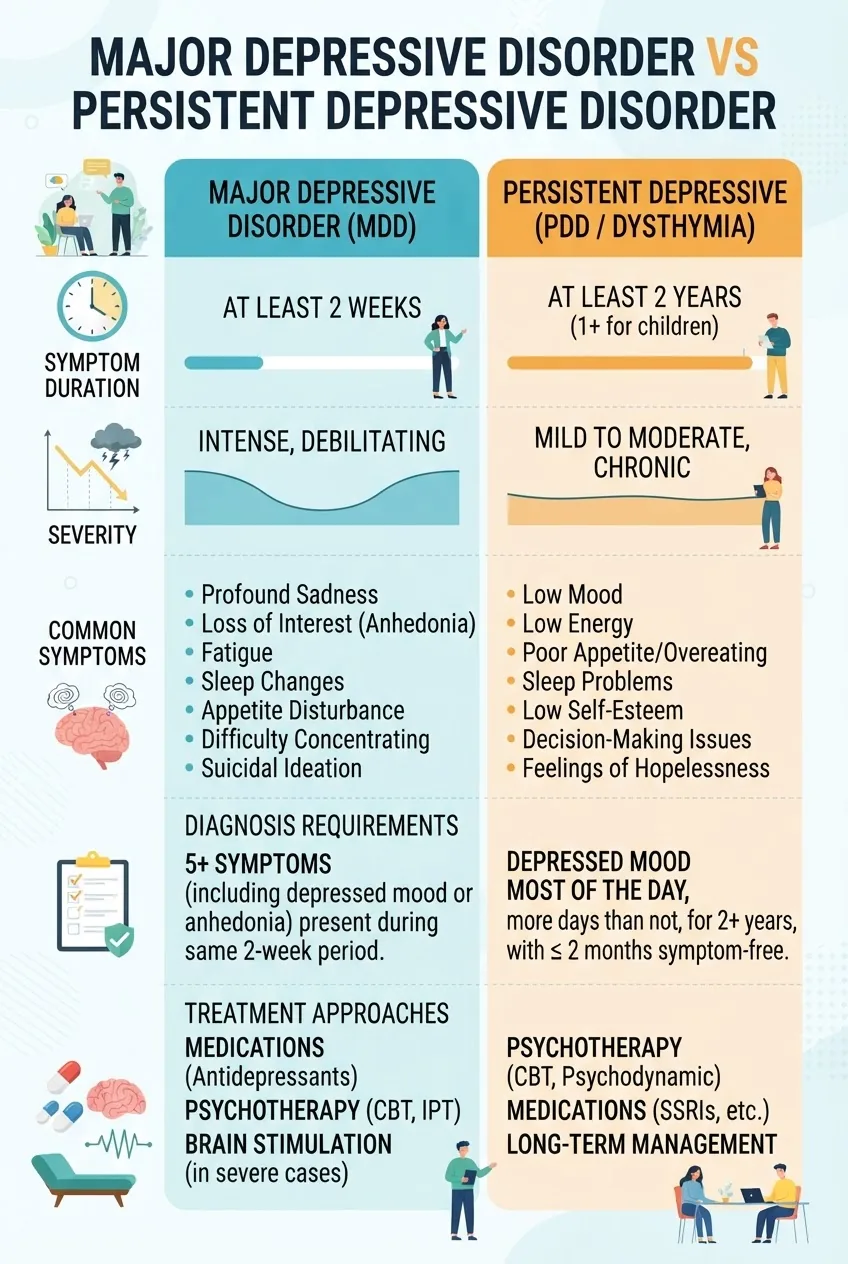
Answer: Major depressive disorder (MDD) is characterised by discrete, typically more severe episodes meeting a higher symptom count and shorter minimum duration (≥2 weeks), while persistent depressive disorder (PDD) is defined by longer duration (≥2 years) with fewer required symptoms but chronic impairment.
The table below summarizes the primary clinical differences between MDD and PDD as used in DSM-5 diagnostic reasoning.
| Feature | Major Depressive Disorder (MDD) | Persistent Depressive Disorder (PDD) |
|---|---|---|
| Minimum duration | ≥2 weeks of a major depressive episode | ≥2 years (adults) of chronic depressive symptoms |
| Symptom threshold | Five or more core symptoms including depressed mood or anhedonia | Depressed mood plus ≥2 additional symptoms (lower numeric threshold) |
| Course | Episodic, may remit between episodes | Chronic, persistent, may include superimposed major episodes (“double depression”) |
| Severity | Often more severe symptoms and functional impairment acutely | Lower-grade symptoms but sustained functional impact |
| Treatment approach | Acute antidepressant and psychotherapy protocols for episodes | Longer-term maintenance therapy and integrated psychosocial strategies |
Brief analysis: Clinicians prioritize duration and course to differentiate PDD from MDD; MDD requires a higher symptom count over shorter time, while PDD’s clinical management focuses on sustained engagement, relapse prevention and addressing entrenched negative cognitions.
Transition: With core differences clarified, the next section drills into symptom patterns across depressive presentations to help readers and clinicians distinguish features in practice.
Symptoms Overview: Persistent Depressive Disorder vs Other Depression Types
Answer: Symptoms of persistent depressive disorder include chronic low mood, low energy, poor concentration, sleep/appetite disturbances and low self-esteem, while other depression types (e.g., MDD, atypical, psychotic) differ by symptom intensity, episodic vs chronic course, and presence of atypical or psychotic features.
Term: symptoms of dysthymic disorder — the observable signs and subjective complaints typical of PDD, emphasising duration and persistence.
Symptom comparison bullets:
- Persistent Depressive Disorder (PDD): Ongoing low mood most days, low energy, poor concentration, low self-esteem, sleep or appetite changes, hopelessness; symptoms persist ≥2 years with limited symptom-free intervals.
- Major Depressive Disorder (MDD): Discrete episodes with at least five symptoms including depressed mood or anhedonia for ≥2 weeks; higher acute severity and suicidal risk can be elevated.
- Atypical depression: Mood reactivity with increases in appetite/weight and hypersomnia, interpersonal rejection sensitivity; see atypical depression symptoms and treatment options for contrasts.
- Psychotic depression: Depressive symptoms accompanied by psychotic features (delusions/hallucinations) requiring specific antipsychotic/ECT considerations; see psychotic depression symptoms and treatments.
- Bipolar depression: Depressive episodes within a bipolar disorder context; requires mood-stabilizing strategies and rule-out of unrecognized hypomanic/manic episodes via structured interview (see bipolar guide).
Distinguishing related symptom patterns and presentations:
- Fatigue vs depression: assess for predominant physical tiredness without mood symptoms — see distinguishing fatigue from depression symptoms.
- High-functioning depression: persistent symptoms with preserved external functioning; contrast with PDD where chronic functional impairment is common — see high functioning depression symptoms.
- Depression cycle dynamics: recognise maintenance factors (avoidance, rumination) — see understanding and breaking the depression cycle.
Transition: Symptom recognition guides treatment selection; the next section summarises evidence-based interventions for PDD, including strategies for treatment-resistant cases.
Treating Persistent Depressive Disorder: Evidence-Based Approaches
Answer: Effective treatment for PDD typically combines psychotherapy (CBT, IPT, behavioural activation), antidepressant medication (SSRIs, SNRIs), and long-term management strategies; treatment-resistant cases may require combination therapy, augmentation, neuromodulation or specialist referral.
Term: persistent depressive disorder treatments — the array of evidence-based pharmacological and psychotherapeutic interventions used to manage PDD.
First-line psychological therapies:
- Cognitive Behavioural Therapy (CBT): targets entrenched negative beliefs and behavioural patterns; evidence supports long-term benefit when adapted for chronic depression.
- Interpersonal Psychotherapy (IPT): addresses relationship and role issues that maintain low mood.
- Behavioural Activation (BA): focuses on increasing rewarding activities and reducing avoidance — practical for chronic low-motivation presentations.
- Long-term psychotherapy: psychodynamic or schema-focused approaches can be considered for entrenched personality or relational patterns sustaining PDD.
Medication strategies:
- First-line antidepressants: SSRIs (e.g., sertraline, escitalopram) and SNRIs (e.g., venlafaxine) are commonly used for PDD with symptom monitoring via PHQ-9/HAM-D.
- Dosing and duration: sustained treatment (often >6–12 months) with close monitoring for response; discontinuation should be gradual and supervised.
- Augmentation strategies: where partial response occurs, clinicians may add atypical antipsychotics, lithium or buspirone depending on symptom profile and evidence base.
- Medication considerations in chronic depression dysthymia: treat persistence and residual symptoms aggressively to improve long-term functioning.
Evidence-based advanced and specialist options:
- Combination therapy: psychotherapy plus antidepressant produces higher response and remission rates than either alone in PDD and double depression.
- Transcranial magnetic stimulation (TMS): evidence supports use in treatment-resistant depression, including some chronic presentations.
- Electroconvulsive therapy (ECT): considered for severe, treatment-resistant, or psychotic depression; effectiveness extends to chronic presentations with severe functional decline.
- Novel agents and approaches: ketamine/esketamine formulations have evidence for rapid antidepressant effects in treatment-resistant cases, often as part of specialist care.
Treatment-resistant depression context: Persistent depressive disorder can evolve into a treatment-resistant course when adequate trials of evidence-based therapy and medication fail to achieve remission. For advanced strategies and integrated protocols see treatment for treatment resistant depression and review specialist referral pathways.
major depressive disorder treatment strategies
Practical management principles for clinicians and patients:
- Conduct a full diagnostic review (SCID-5 or MINI) to confirm PDD and rule out bipolar or substance contributors.
- Establish collaborative, long-term treatment goals with regular outcome measurement (PHQ-9 every 4–8 weeks).
- Use stepped-care: start with combined psychotherapy + antidepressant, escalate to augmentation, neuromodulation, or specialist interventions if inadequate response.
- Address social determinants and comorbidities (anxiety, substance use) that perpetuate chronicity.
Clinical case example (treatment-resistant context): A 48-year-old with 5 years of continuous depressive symptoms failed two adequate SSRI trials and 12 months of CBT; the multidisciplinary team initiated augmentation with lithium, switched to an SNRI, commenced adjunctive CBT-focused behavioural activation, and referred for TMS assessment — demonstrating multimodal escalation in chronic, treatment-resistant PDD.
Transition: Knowing when to escalate care and seek specialized assessment is crucial; the next section outlines actionable steps for seeking professional help and diagnostic assessment.
When to Seek Professional Help: Diagnosis and Assessment Process
Answer: Seek professional help when depressive symptoms persist beyond two weeks with functional decline, when symptoms are chronic (≥2 years), or when safety concerns exist; clinicians use structured interviews, rating scales and medical work-ups to confirm DSM-5 diagnoses and plan treatment.
Term: assessment tools — validated instruments and structured interviews (PHQ-9, SCID-5, HAM-D, MINI) used by clinicians to diagnose depressive disorders per DSM-5.
- Step 1 — Immediate safety: If suicidal ideation, self-harm intent or severe functional collapse is present, seek emergency care or urgent psychiatric review.
- Step 2 — Primary care assessment: initial screening with PHQ-9 and basic medical work-up (thyroid, B12, FBC) to exclude medical causes.
- Step 3 — Specialist diagnostic interview: referral for a psychiatrist or psychologist for SCID-5/MINI structured interview to apply DSM-5 criteria and differential diagnosis.
- Step 4 — Treatment planning: discuss evidence-based options, consider combined psychotherapy and medication, and set monitoring schedule (PHQ-9/HAM-D) and relapse prevention plan.
- Step 5 — Referral triggers: consider specialist referral for treatment-resistant cases, suspected bipolar spectrum, psychosis, or when neuromodulation/ECT is being considered. severe depression relapse prevention
Local treatment guidance: clinicians in Australia often consult the Australian Government health guidance and professional bodies when adapting treatment algorithms to local resources and reimbursement contexts; see Australian clinical resources for specific protocols. depression prevalence in Australia
Transition: Below are key takeaways and next steps for readers and clinicians assessing and managing depressive disorders under DSM-5.
Conclusion
Persistent depressive disorder under DSM-5 is defined by chronicity (≥2 years) and a distinct clinical course from episodic major depressive disorder. Accurate diagnosis requires structured interviews, duration and exclusion criteria, and long-term, often combined treatment strategies. If symptoms persist or worsen despite treatment, consult specialist services for advanced interventions.
Call to action: If you or a client have chronic depressive symptoms, arrange a comprehensive assessment with a GP or psychiatrist to map symptoms to DSM-5 criteria and develop a sustained treatment plan.
References and authoritative resources: