

This guide presents a clinical, DSM‑5‑focused overview of depressive disorders, summarising classifications, Major Depressive Disorder (MDD) criteria, diagnostic steps, differential diagnosis and specifiers to inform accurate assessment and treatment planning within routine psychiatric practice.
Overview of DSM 5 Depressive Disorders
Answer: DSM‑5 depressive disorders are a set of diagnostic categories in the American Psychiatric Association’s manual that describe syndromes primarily characterised by depressed mood and/or loss of interest or pleasure, used as a clinical checklist or “diagnostic blueprint” to guide assessment and treatment decisions.
DSM 5 depressive disorders: the DSM‑5 (Diagnostic and Statistical Manual of Mental Disorders, Fifth Edition) groups several disorders under “depressive disorders” to provide categorical diagnoses for clinical care and research, emphasising symptom clusters, duration, severity and functional impact (American Psychiatric Association, DSM‑5).
The DSM‑5 framework functions as a mood disorders classification system that helps clinicians identify specific depressive disorders (e.g., Major Depressive Disorder, Persistent Depressive Disorder) and apply specifiers that affect prognosis and treatment selection. Clinicians should treat DSM‑5 as a diagnostic checklist and interpret it alongside clinical judgment, patient history and contextual factors.
Term: categorical diagnosis — classification into a named disorder based on specified criteria rather than a dimensional score.
Key elements of the DSM‑5 approach to depressive disorders include symptom clusters (mood, cognitive, neurovegetative), duration thresholds, exclusion criteria (medical, substances, bipolar), specifiers (melancholic, atypical, psychotic), and severity/functioning ratings. For Australian clinicians, regional prevalence and service guidelines should inform assessment and referral pathways — see Australian Government Department of Health for national resources (official guidance, 2024).
According to a 2024 industry report, the language and organisation of depressive disorder criteria remain widely used in clinical settings for treatment planning and research (industry report, 2024).
Common practical uses in clinic:
- Mapping symptom clusters to diagnostic criteria for episode identification.
- Applying specifiers to tailor treatment expectations and urgency.
- Using exclusion rules to differentiate bipolar and substance-induced presentations.
Transition: The next section details the precise criteria for Major Depressive Disorder and the nine symptom domains used in clinical diagnosis.
Major Depressive Disorder in DSM 5: Diagnostic Criteria and Symptomatology
Answer: Major Depressive Disorder (MDD) requires at least five of nine specific symptoms present during a two‑week period, representing a change from prior functioning, including either depressed mood or loss of interest/pleasure, with clinically significant distress or impairment and exclusion of bipolar, substance, or medical causes (APA, DSM‑5).
Term: episode severity — a clinical judgement about symptom intensity and functional impairment (mild, moderate, severe).

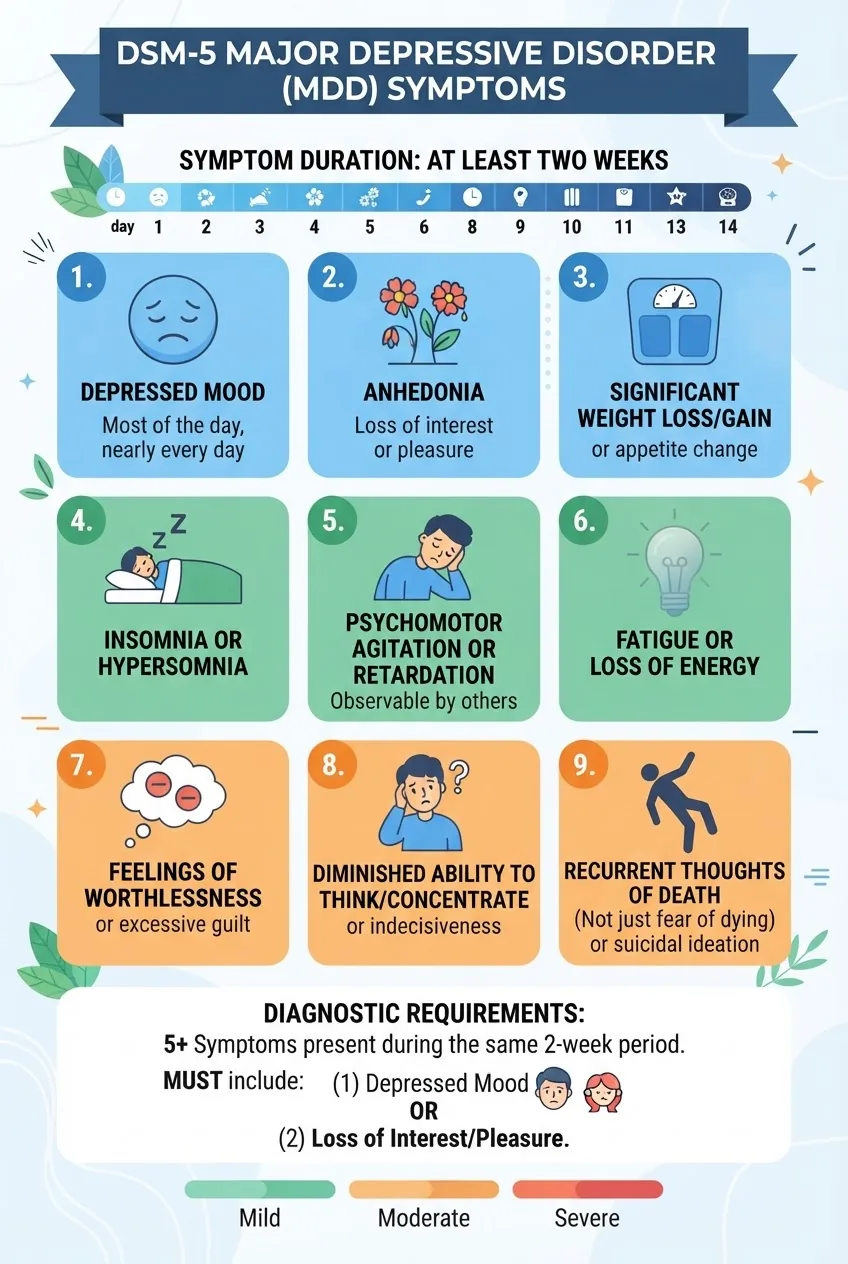
- Criterion A — Core symptoms (required):
- Depressed mood most of the day, nearly every day (subjective report or observation).
- Markedly diminished interest or pleasure in all, or almost all, activities most of the day, nearly every day (anhedonia).
At least one of these two must be present.
- Criterion B — Additional symptoms (need enough to total five):
- Significant weight loss or gain, or decrease/increase in appetite.
- Insomnia or hypersomnia nearly every day.
- Psychomotor agitation or retardation observable by others.
- Fatigue or loss of energy nearly every day.
- Feelings of worthlessness or excessive/inappropriate guilt.
- Diminished ability to think or concentrate, indecisiveness.
- Recurrent thoughts of death, suicidal ideation or attempts.
- Criterion C — Functional impact:
Symptoms must cause clinically significant distress or impairment in social, occupational, or other important areas of functioning.
- Criterion D — Exclusion of other causes:
Symptoms are not attributable to physiological effects of a substance or another medical condition, and there has never been a manic or hypomanic episode (to exclude bipolar disorder).
- Criterion E — Episode duration:
Symptoms must be present for at least a two‑week period and represent a change from previous functioning.
Clinical thresholds and episode severity:
- Count core + additional symptoms (≥5 for episode); clinicians apply severity categories (mild/moderate/severe) based on symptom count, intensity, and functional impairment.
- Suicidal ideation or psychotic features automatically increase urgency and often severity designation.
PHQ‑9 and other rating scales in diagnostic assessment: A structured screening tool like the Patient Health Questionnaire‑9 (PHQ‑9) can corroborate symptom presence and severity; see PHQ‑9 scoring table below for use as a diagnostic adjunct.
| PHQ‑9 score | Interpretation |
|---|---|
| 0–4 | None–minimal |
| 5–9 | Mild depressive symptoms |
| 10–14 | Moderate; consider diagnostic interview |
| 15–19 | Moderately severe; treatment indicated |
| 20–27 | Severe; urgent assessment and likely treatment |
Clinical example (anonymised vignette): A 42‑year‑old teacher reports two weeks of pervasive low mood, 6 kg weight loss, insomnia, loss of interest in hobbies and daily dysfunction; PHQ‑9 = 18 — this meets DSM‑5 criteria for a current major depressive episode, moderate‑to‑severe, and requires safety assessment and treatment planning.
Term: exclusion criteria — conditions or factors that must be ruled out (e.g., substances, medical illness, bipolar disorder) before assigning a depressive disorder diagnosis.
Fatigue vs depression: Distinguish primary fatigue from fatigue as a depressive symptom by assessing associated mood, anhedonia, cognitive slowing and temporal pattern; see fatigue vs depression symptoms for a targeted comparison.
Presentation variations: Clinicians should be alert for presentations such as high functioning depression, where individuals meet criteria but maintain external role functioning.
Transition: After defining MDD criteria, the next section outlines the other DSM‑5 depressive disorder categories clinicians encounter and how their diagnostic thresholds differ.
Other DSM 5 Depressive Disorders: Brief Descriptions and Diagnostic Features
Answer: DSM‑5 lists other depressive disorders including Persistent Depressive Disorder (dysthymia), Disruptive Mood Dysregulation Disorder, Premenstrual Dysphoric Disorder, Substance/Medication‑Induced Depressive Disorder, and Depressive Disorder Due to Another Medical Condition — each has distinct duration, age‑of‑onset or etiologic qualifiers used to guide diagnosis.
Persistent Depressive Disorder: a chronic depressive condition combining dysthymia and chronic major depressive episodes; diagnosis requires depressed mood for most of the day for at least two years in adults (one year for children/adolescents) with fewer symptom thresholds but sustained functional impact.
persistent depressive disorder
Disruptive Mood Dysregulation Disorder (DMDD): severe recurrent temper outbursts with persistent irritable/angry mood between outbursts, diagnosed in children/adolescents (onset before 10 years) to avoid overdiagnosing bipolar disorder in youths.
Premenstrual Dysphoric Disorder (PMDD): marked mood symptoms during the luteal phase of the menstrual cycle with significant functional interference, resolving shortly after menses begins.
Substance/Medication‑Induced Depressive Disorder: depressive symptoms that develop during or soon after substance intoxication/withdrawal or exposure to medication, where substance exposure is clinically implicated in symptom onset.
Depressive Disorder Due to Another Medical Condition: depressive symptoms judged to be a direct physiological consequence of another medical condition (e.g., hypothyroidism, Parkinson’s disease).
Symptom lists (sub‑bullets for clinical comparison):
- Persistent Depressive Disorder
- Depressed mood majority of days for ≥2 years (adults)
- Presence of two or more symptoms (appetite change, sleep disturbance, low energy, low self‑esteem, poor concentration, hopelessness)
- No prolonged symptom‑free period >2 months during the two years
- Disruptive Mood Dysregulation Disorder
- Severe temper outbursts, inconsistent with developmental level
- Persistent irritable mood between outbursts
- Frequency: ≥3 times/week across at least 12 months and in ≥2 settings
- Premenstrual Dysphoric Disorder
- Marked affective lability, irritability, depressed mood or anxiety in luteal phase
- Symptoms improve within a few days after menses onset
- Prospective confirmation recommended (daily ratings)
- Substance/Medication‑Induced & Medical Condition Depressive Disorders
- Temporal relationship with exposure/medical condition
- Symptoms exceed expected physiological effects
- Rule out independent depressive disorder if symptoms persist after exposure resolves
Clinical note: When depressive features occur alongside another primary psychiatric disorder (e.g., psychotic disorders), specify the primary disorder and code depressive features accordingly; refer to specialty guidance and local practice frameworks, including Australian recommendations for comorbidity assessment (Australian Government Department of Health, 2024).
Transition: With these diagnostic categories clear, the following section offers a step‑by‑step clinical diagnosis process grounded in DSM‑5 criteria and practical interview techniques.
Clinical Diagnosis Process for DSM 5 Depressive Disorders
Answer: A reliable clinical diagnosis of DSM‑5 depressive disorders follows a structured process: screening with validated scales, comprehensive psychiatric and medical history, mental status examination, use of DSM‑5 criteria and specifiers, differential diagnosis and safety assessment, and documentation of functional impact and comorbidities.

- Initial screening and presentation triage
Use tools like the PHQ‑9 for adults, K10 for population screening, or brief clinician‑rated scales to identify likely disorder presence and immediate risk (suicidality, psychosis). If PHQ‑9 ≥15 or active suicidal ideation, escalate to urgent safety planning.
- Comprehensive psychiatric interview
Obtain detailed symptom chronology (onset, duration, course), prior episodes, family psychiatric history, current stressors, cultural and developmental context, and prior treatment response. Ask targeted questions to determine whether core DSM‑5 criteria are met (number and duration of symptoms, change from baseline).
- Medical and substance review
Screen for medical mimics (thyroid disease, vitamin B12 deficiency, neurological disorders) and for prescription or recreational substances known to cause depressive symptoms. Order relevant labs and liaise with primary care when indicated.
- Use of rating scales and structured tools
Incorporate PHQ‑9 for symptom severity tracking and HAM‑D or MADRS for more detailed severity and treatment monitoring in specialist settings. Present a short scoring vignette for PHQ‑9 interpretation: a score of 16 suggests moderately severe depression and warrants active treatment and safety assessment.
- Apply DSM‑5 diagnostic checklist
Systematically map reported symptoms against DSM‑5 criteria: count symptoms, confirm two‑week minimum for MDD, document impairment and exclusion criteria, and decide on specifiers (e.g., anxious distress, peripartum onset).
- Differential diagnosis and comorbidity assessment
Evaluate for bipolar spectrum illness (past hypomania/mania), anxiety disorders, PTSD, personality disorders, and medical conditions. Use collateral history where available—partners or family can reliably report past mood elevation or behavioural changes not acknowledged by the patient.
- Safety and functional assessment
Conduct suicide risk assessment at every contact; evaluate intent, plan, means, and protective factors. Document functional impairment across work, relationships and activities — use clinician‑rated global functioning scales if needed.
- Diagnosis formulation and documentation
Record the DSM‑5 diagnosis, chosen specifiers, severity, comorbid conditions, and the rationale for exclusions. Include a clear plan for follow‑up, treatment recommendations and crisis actions.
- Follow‑up and reassessment
Repeat symptom scales (PHQ‑9, HAM‑D) routinely to monitor response and detect relapse; see severe depression relapse for relapse prevention strategies.
Clinician walkthrough (structured interview vignette): During a 45‑minute diagnostic interview, the clinician introduces the DSM‑5 symptom checklist, elicits a two‑week symptom timeline, screens for mania, conducts PHQ‑9, orders TSH and B12, and documents exclusion of substance causes; the result is a formal MDD diagnosis with the anxious distress specifier and a safety plan.
Case vignette (treatment‑resistant context): A patient with recurrent MDD who failed two adequate antidepressant trials requires careful review of diagnostic accuracy (rule out bipolar spectrum, substance effects, medical contributors) before labelling as treatment‑resistant; accurate DSM‑5 diagnosis shapes the next treatment steps.
Documentation tips:
- Explicitly state which DSM‑5 criteria are met and which are excluded.
- Record PHQ‑9 or HAM‑D scores with dates.
- Note collateral sources and their contribution to diagnosis.
Transition: Precise differential diagnosis is crucial; the next section discusses common diagnostic challenges and how to distinguish similar presentations.
Differential Diagnosis and Common DSM 5 Diagnostic Challenges
Answer: Differential diagnosis for depressive presentations focuses on excluding bipolar disorder, substance‑induced mood symptoms, medical mimics, anxiety disorders and cultural or developmental presentations by using targeted history, collateral information, screening tools and sometimes longitudinal observation.
Term: differential diagnosis — the systematic process of distinguishing a condition from others that present with similar clinical features.
Key diagnostic challenges include:
- Undetected bipolar disorder: Past hypomanic episodes may be subtle; clinicians must actively screen for periods of elevated energy, decreased need for sleep, grandiosity or risky behaviour. See bipolar disorder exclusion for detailed differentiation guidance.
- Substance or medication effects: Temporal relationship and substance history clarify whether mood symptoms are primary or substance‑related.
- Medical mimics: Endocrine, neurological and autoimmune conditions can produce depressive symptoms — targeted testing and liaison with medical colleagues are essential.
- Anxiety and PTSD comorbidity: Overlapping symptoms such as sleep disturbance, concentration problems and irritability require careful symptom attribution.
- Cultural presentations: Cultural norms about emotional expression can alter symptom reporting and risk of misdiagnosis.
| Condition | Key distinguishing features | Diagnostic actions |
|---|---|---|
| Major Depressive Disorder | ≥5 DSM‑5 symptoms for 2 weeks; depressed mood/anhedonia; no mania | Structured history; PHQ‑9; rule out substances/medical causes |
| Bipolar disorder | History of hypomania/mania; episodic elevated mood/energy | Collateral history; mood charts; assessment of past antidepressant-induced mania |
| Substance-induced mood disorder | Temporal link to substance use/withdrawal | Toxicology, timeline analysis, repeat assessment after abstinence |
| Medical condition (e.g., hypothyroid) | Systemic symptoms, lab abnormalities | Targeted medical tests; medical specialist input |
Bipolar screening practical tip: Ask about periods of several days of decreased need for sleep with increased goal‑directed activity, during which the patient was “not themselves.” Collateral reports often reveal hypomania missed by self‑report.
Cultural/age considerations: In older adults, cognitive impairment and medical comorbidity complicate assessment; in adolescents, irritability may predominate over reported low mood. Use developmentally appropriate questions and, if necessary, cognitive screening (e.g., MoCA) when the presentation is atypical.
When uncertainty persists: Use time‑limited diagnostic formulation with follow‑up, mood diaries, collateral information and, if needed, trial of treatment while monitoring closely. Avoid premature labelling of treatment resistance without thorough diagnostic review — see severe depression relapse linkage for relapse risk considerations.
Transition: With differential diagnosis clarified, clinicians must select specifiers that inform prognosis and treatment choices — the next section outlines DSM‑5 specifiers and their clinical relevance.
DSM 5 Specifiers and Subtypes for Depressive Disorders and Their Clinical Relevance
Answer: DSM‑5 specifiers (e.g., melancholic, atypical, psychotic features, seasonal pattern, anxious distress, peripartum onset) provide additional detail about symptom patterns and guide prognostic expectations and treatment selection, as some specifiers predict different medication or therapy responses.
Term: specifier — an additional label added to a primary diagnosis to describe symptom patterns, course, or features that affect clinical management.
- Melancholic features
- Clinical features: profound anhedonia, early morning awakening, diurnal mood variation, marked psychomotor changes, excessive guilt.
- Clinical implication: often responds well to antidepressant medication and electroconvulsive therapy in severe cases; consider biological treatments.
- Atypical features
- Clinical features: mood reactivity, significant weight gain/increased appetite, hypersomnia, leaden paralysis, interpersonal rejection sensitivity.
- Clinical implication: may respond preferentially to MAOIs historically, and modern strategies emphasise SSRIs, psychotherapy and adjunctive treatments; see atypical depression features for deeper guidance.
- Psychotic features
- Clinical features: mood‑congruent or mood‑incongruent delusions or hallucinations occurring in the context of a depressive episode.
- Clinical implication: requires combined antidepressant and antipsychotic therapy, often inpatient care for safety and monitoring; see psychotic features in depression.
- Seasonal pattern (seasonal affective pattern)
- Clinical features: regular temporal relationship between onset of depressive episodes and particular seasons.
- Clinical implication: light therapy, targeted behavioural strategies and specific pharmacotherapy timing may be helpful.
- Anxious distress
- Clinical features: prominent anxiety symptoms during a depressive episode (e.g., tension, worry, fear).
- Clinical implication: predicts higher risk of suicide and poorer treatment response; consider adjunctive treatments for anxiety.
- Peripartum onset
- Clinical features: onset during pregnancy or within four weeks postpartum, often with heightened risk and special treatment considerations (lactation, neonatal exposure).
- Clinical implication: involve obstetric care, consider rapid‑acting treatments and safety planning; consultation with perinatal psychiatry recommended.
Clinical implications summary:
- Specifiers alter risk stratification (e.g., psychotic features = higher suicide risk, melancholic = potential better biological treatment response).
- Specifiers guide choice and intensity of interventions and monitoring frequency.
- Always record the rationale for chosen specifiers in the diagnostic note.
Transition: Accurate DSM‑5 diagnosis and specifier use are especially important when managing patients with incomplete response to standard therapies; the next section connects diagnosis to treatment‑resistant depression considerations.
Implications of DSM 5 Diagnosis for Treatment-Resistant Depression
Answer: DSM‑5 diagnosis affects identification of treatment‑resistant depression (TRD) by confirming correct disorder, excluding bipolar or medical causes, specifying features that predict response, and informing evidence‑based escalations such as medication augmentation, psychotherapy modifications, or neuromodulation approaches.
Term: treatment‑resistant depression (TRD) — commonly defined clinically as inadequate response to two or more adequate antidepressant trials, although definitions vary by guideline.
Accurate DSM‑5 diagnosis is central to TRD management: misdiagnosis (e.g., undetected bipolar disorder) often explains apparent resistance; specifiers (anxious distress, psychotic features) change medication choices; comorbidities require simultaneous treatment. For detailed treatment strategies beyond diagnosis, refer to the pillar page on treatment for treatment resistant depression.
major depressive disorder treatment
Clinical workflow implications:
- Confirm DSM‑5 diagnostic accuracy before labelling TRD.
- Use specifiers to prioritise interventions (e.g., psychotic features → antipsychotic augmentation; melancholic features → consider biological treatments).
- Systematically review prior treatment adequacy (dose, duration, adherence, tolerability) and comorbid contributors.
Experience signal: An anonymised clinic example: a patient with two failed SSRI trials had previously unrecognised hypomanic episodes; after bipolar reclassification, mood stabiliser addition led to clinical improvement — demonstrating the centrality of correct DSM‑5 diagnosis to avoid inappropriate TRD labelling.
Transition: The concluding section summarises and offers a brief DSM vs ICD comparison and recent DSM‑5 updates relevant to depressive disorders.
DSM 5 Depressive Disorders (DSM vs ICD and Recent Updates): What Clinicians Should Know?
Answer: DSM‑5 and ICD‑11 share core depressive disorder constructs but differ in coding, some thresholds and emphasis on dimensional specifiers; recent DSM‑5 updates emphasise specifiers, crosswalks to ICD, and clinician judgement in complex cases — always document rationale and consider local coding standards.
DSM vs ICD comparison (brief):
| Domain | DSM‑5 | ICD‑11 |
|---|---|---|
| Approach | Categorical with specifiers; clinical checklist (APA DSM‑5) | Global clinical diagnostic system with comparable categories and different coding (WHO ICD‑11) |
| Specifiers | Multiple specifiers (melancholic, atypical, anxious distress) | Similar features but varying emphasis; ICD‑11 uses modifiers |
| Use in practice | Widely used in psychiatry and research; influences treatment choices | Used internationally for epidemiology and clinical coding; often interoperable with DSM |
DSM‑5 updates relevant to depression:
- Greater emphasis on cross‑cutting symptom measures for dimensional assessment (APA resources, DSM‑5 guidance).
- Integration of specifiers that influence treatment selection and prognosis.
- Recognition of age‑ and developmentally specific disorders (e.g., DMDD) to reduce misdiagnosis.
Limitations and clinician judgment: DSM‑5 provides a diagnostic blueprint but has limitations: cultural context and dimensional severity are not fully captured in categorical labels. Clinician judgment and longitudinal assessment remain essential; document the reasoning for diagnostic decisions and monitor outcomes.
External authority and further reading: Refer to the American Psychiatric Association (APA) DSM‑5 manual for canonical criteria (APA DSM resources) and peer‑reviewed journals for contemporary controversies and evidence on specifier validity (e.g., Lancet Psychiatry, Journal of Clinical Psychiatry).
Transition: Key takeaways follow, with a call to action for clinicians to apply structured DSM‑5 assessment to improve diagnostic accuracy and treatment outcomes.
Conclusion
Answer: Accurate DSM‑5 diagnosis of depressive disorders—via structured screening, comprehensive history, exclusion of bipolar/substance/medical causes, and appropriate use of specifiers—directly informs prognosis and treatment choices and reduces misclassification of treatment resistance.
Key takeaways:
- Apply DSM‑5 criteria systematically and document which criteria are met and excluded (APA DSM‑5 manual as reference).
- Use validated rating scales (PHQ‑9, HAM‑D, MADRS) to quantify severity and monitor response.
- Always screen for bipolar features, substance effects and medical mimics before declaring TRD.
- Use specifiers to tailor interventions and anticipate prognosis.
- When uncertain, use longitudinal follow‑up and collateral information to refine the diagnosis.
For clinicians seeking treatment pathways after accurate DSM‑5 diagnosis, review our detailed protocols on treatment for treatment resistant depression and the practical strategies in major depressive disorder treatment.
Call to action: Use this guide as a clinical checklist in diagnostic interviews, document thoroughly, and refer to specialist services when diagnostic complexity or treatment resistance persists.