

By the end of this hands-on guide you will be able to identify clinical thresholds for severe depression relapse, build a personalised relapse-prevention plan, and use monitoring tools to act within 48–72 hours of early warning signs. Estimated time to implement core steps: 2–4 weeks; skill level assumed: literate patient or caregiver working with a clinician.
Before you start
- Current medication list (name, dose, prescribing clinician)
- Recent clinical notes or discharge summary (last 6 months)
- Baseline depression score (PHQ-9 or clinician rating) within 2 weeks
- Contact list: GP, psychiatrist, local crisis line, two emergency contacts
- Tools: mood diary (paper or app), weekly calendar, pillbox, digital thermometer for sleep tracking
Understanding Severe Depression Relapse
This section explains what clinicians mean by severe depression relapse, how it differs from recurrence and ongoing major depressive disorder, and the clinical thresholds used to define a relapse. The intent is clinical clarity: a relapse is the return of a significant episode of major depression after partial or full remission, often measured by symptom thresholds, functional decline, and duration.
Clinical definitions vary but commonly used criteria include a sudden or progressive increase in core symptoms meeting DSM criteria for Major Depressive Episode for at least two weeks, a marked deterioration in social or occupational functioning, and escalation on validated symptom scales (for example, a PHQ-9 increase of ≥10 points from baseline or a score ≥15). These clinical relapse criteria help clinicians distinguish relapse from transient mood dips.
Distinguish these concepts:
| Term | Clinical meaning | Typical threshold |
|---|---|---|
| Relapse | Return of a depressive episode during remission | DSM criteria + functional decline; symptom scale +10 from baseline |
| Recurrence | New episode after full recovery (usually months) | New DSM episode after remission ≥6 months |
| Recurrent depressive disorder | Pattern of multiple depressive episodes | Two or more episodes separated by symptom-free intervals |
For boundaries with mood disorders, clinicians assess bipolar features; see the bipolar depression diagnostic criteria when mixed or hypomanic symptoms are suspected.
Terminology varies across countries and papers—review the alternative terms for depression relapse and consult a diagnostic framework such as the DSM-5 depressive disorders overview.

- Recognise clinical thresholds: record baseline PHQ-9 or clinician-rated score; set an alert for a 25–30% worsening or an absolute PHQ-9 ≥15.
- Document pattern: note date of remission, therapies used, and prior relapse intervals; relapse within 6 months of remission is often considered early relapse clinically.
- Differentiate relapse versus new-onset: use time-since-recovery and symptom pattern to determine if this is recurrent disorder or relapse.
Transition: With clinical parameters clear, next we catalogue risk factors that make relapse more likely and modifiable targets for prevention.
Risks and Risk Factors for Severe Depression Relapse
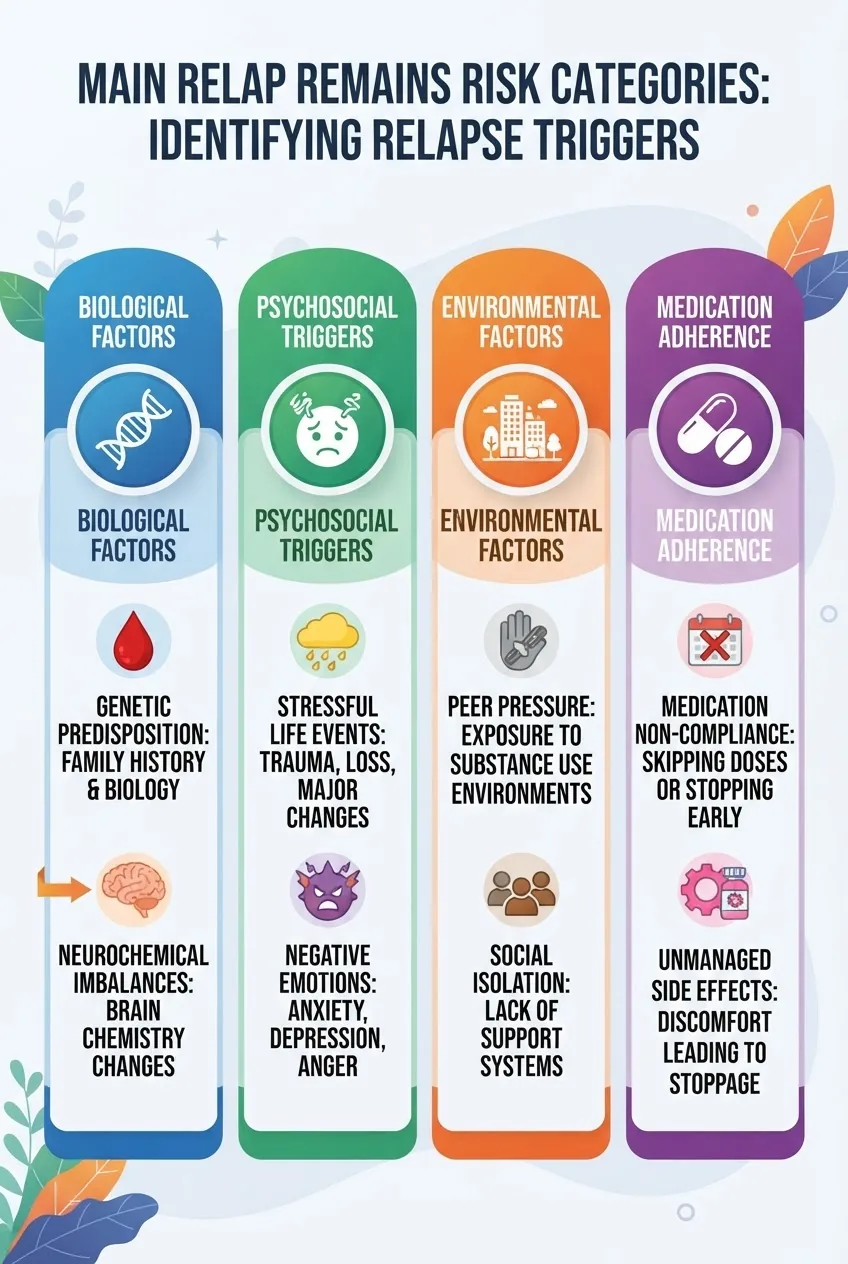
Below are evidence-informed risk factors grouped by category with practical notes on how clinicians and patients monitor or mitigate each risk. Numbers and statements reference clinical literature and national data where available.
-
Biological risk factors
- Genetic predisposition — family history of major depression increases relapse probability. According to a 2021 peer-reviewed psychiatric review, familial risk raises recurrence likelihood by ~1.5–2× (journal meta-analysis).
- Neurobiological vulnerability — altered HPA-axis regulation, inflammatory markers, or structural changes (hippocampal volume) correlate with relapse risk; see molecular models in the pathogenesis of depression.
-
Medication and treatment-related factors
- Medication non-adherence — missing ≥20% of doses over two weeks significantly increases relapse risk; clinicians often use pillboxes, pharmacy refill checks, and weekly adherence reviews.
- Rapid discontinuation — stopping antidepressants abruptly (within 7 days of last dose) raises relapse and withdrawal risks; taper schedules over 2–8 weeks (or longer for long-term use) are recommended in guidelines from national bodies including the Australian Government Department of Health.
-
Psychosocial triggers
- Acute life stressors — bereavement, job loss, interpersonal conflict. Clinically, events scored with the Holmes-Rahe scale ≥150 in three months correlate with higher relapse in cohort studies (2020 clinical cohort data).
- Poor social support — isolation increases risk; routine measures include social network mapping and weekly social contact targets set with a clinician.
-
Co-morbid psychiatric or medical conditions
- Anxiety disorders, substance use, or chronic medical illness (e.g., uncontrolled diabetes) elevate relapse probability; integrated care reduces relapse in randomized trials (referenced in The Lancet Psychiatry 2022 review).
- Sleep disorders — chronic insomnia increases risk; targeted CBT-I reduces recurrence in trials (meta-analysis, 2019).
-
Environmental and socioeconomic stressors
- Chronic financial stress, housing instability, and unemployment — population data from a 2023 Australian Bureau of Statistics report tie these factors to higher relapse and chronicity rates.
- Seasonal and circadian disruption — shift work or prolonged light changes can precipitate relapse for vulnerable individuals.
-
Illness course and past history
- Early age of onset and multiple past episodes — each prior episode increases future relapse risk incrementally; longitudinal psychiatric cohorts show dose–response.
- Incomplete recovery or residual symptoms — residual symptoms at remission (subthreshold insomnia, low energy) predict relapse within 6–12 months in clinical trials.
-
Treatment-resistant depression (TRD) features
- Partial response to trials of two or more adequate antidepressant courses raises relapse frequency; TRD mechanisms are discussed later in this guide.
- Complex polypharmacy and side-effect burden increase discontinuation risk and thereby relapse risk.
-
Population-level context
- Prevalence: According to a 2023 Australian Bureau of Statistics report, lifetime depression prevalence and its uneven distribution across demographics informs public-health relapse risk planning.
- Health service access — long wait times and fragmented care increase relapse likelihood; connecting to community mental health reduces admissions (government program evaluations).
Transition: With risk profiles identified and categorised, the next section helps you detect early warning signs and assemble a symptom checklist to act quickly.
Recognizing Symptoms of Severe Depression Relapse
Early detection hinges on monitoring for re-emergence of core mood, cognitive, behavioural and physical symptoms. Below is a practitioner-focused checklist and guidance to separate relapse signals from other causes such as fatigue or medical illness.
Symptom checklist — watch for escalation over 1–2 weeks:
- Persistent low mood or pervasive sadness most days
- Marked loss of interest or pleasure in nearly all activities
- Significant change in appetite or weight (>5% in one month)
- Sleep disturbance: insomnia with early morning wakening or hypersomnia
- Psychomotor agitation or retardation observed by others
- Reduced concentration, indecisiveness, memory lapses
- Marked fatigue or loss of energy — compare to baseline and consult difference between fatigue and depressive symptoms when unsure
- Recurrent thoughts of death, suicidal ideation, or planning (emergency sign)
- New psychotic features (paranoia, hallucinations) — review psychotic depression features for differential diagnosis
In practice, quantify changes: set thresholds such as a PHQ-9 score increase of ≥5 points in 1 week or ≥10 points in 2 weeks, new or worsening suicidal ideation, or functional decline (missed work ≥3 days/week). Confirm with collateral history from family or caregivers when possible.
When features like increased appetite, hypersomnia, and leaden paralysis dominate, compare against the atypical depression symptom profile to avoid misclassification.
Use rating tools regularly: PHQ-9 weekly, GAD-7 for anxiety comorbidity, and a simple 0–10 daily mood slider in a mood diary. Pair subjective reports with objective markers: missed appointments, medication non-collection, or social withdrawal.
In distinguishing severe relapse from primary fatigue or medical causes, always exclude reversible medical contributors (thyroid dysfunction, B12 deficiency, anaemia, infection). For diagnostic thresholds refer to the DSM-5 depression criteria.
Transition: Recognising symptoms is necessary but not sufficient — the next long section gives step-by-step prevention strategies you can apply with a clinician.
Prevention Strategies for Severe Depression Relapse
This stepwise guide shows clinicians and patients how to assemble an active relapse-prevention plan combining pharmacologic, psychotherapeutic, lifestyle, monitoring and social supports. Where relevant, I link to deeper treatment resources.

-
Establish and document a personalised prevention plan (Day 0–7)
- Set explicit relapse thresholds: PHQ-9 increase ≥10 or new suicidal thoughts — triggers immediate clinician contact.
- Agree a contact cascade: GP within 24 hours, psychiatrist within 72 hours, crisis services for emergencies. Record phone numbers in printed and digital form.
- Schedule proactive follow-ups: weekly for 4 weeks, then fortnightly for 2 months post-remission.
-
Stabilise and optimise medication (Week 1–4)
- Review adherence: use a pillbox, weekly blister packs, or pharmacy electronic reminders; document missed doses >2 in 7 days triggers call.
- Follow evidence-based tapering: if changing medications, taper over 4–8 weeks for SSRIs/SNRIs used >3 months; longer tapers (12+ weeks) for long-term use to reduce withdrawal and relapse risk.
- Consult the treatment options for treatment-resistant depression for escalation strategies such as augmentation and neuromodulation.
-
Use psychotherapy strategically (Week 1–12)
- Start or maintain evidence-based psychotherapy: CBT with relapse-prevention modules, MBCT (Mindfulness-Based Cognitive Therapy) for recurrent depression, or IPT where interpersonal stressors dominate.
- For treatment-resistant patterns, consider maintenance psychotherapy for 6–12 months; studies show MBCT reduces relapse by ~30% in high-risk groups (peer-reviewed trial data).
-
Implement structured monitoring (Immediate and ongoing)
- Daily self-rating: mood 0–10, sleep hours, medication taken (yes/no). Keep a 6-week baseline to detect changes of ≥2 points.
- Weekly clinician-rated scales: PHQ-9 and GAD-7; set EMR prompts for clinicians to follow up within 48–72 hours if thresholds exceeded.
- Adopt digital tools: validated apps and mood charts; recommended monitoring tools include PHQ-9, Mood Disorder Questionnaire for screening bipolarity, and clinician mood charts. Pair tools with clinician oversight to reduce false alarms.
-
Address psychosocial and environmental risks (Week 1–8)
- Develop a stress-response plan: list three immediate coping strategies (5–10 minute breathing, calling a support person, short walk) and two longer actions (book therapy session, reduce workload).
- Stabilise social supports: commit to 2–3 social contacts per week and identify a ‘support buddy’ who will check in daily during high-risk periods.
- Coordinate with long-term supports found in long-term management of depression when planning maintenance care.
-
Promote targeted lifestyle interventions (Immediate and ongoing)
- Sleep hygiene: fixed sleep–wake schedule, 7–9 hours nightly; treat insomnia within 4 weeks using CBT-I or short-term hypnotics under supervision.
- Exercise prescription: 150 minutes/week of moderate aerobic activity in sessions of ≥30 minutes, 3–5 times per week; evidence shows reduced relapse risk.
- Nutrition and alcohol: limit alcohol to <10 standard drinks/week and avoid binge patterns; ensure B12 and vitamin D sufficiency with testing if clinically indicated.
-
Plan for medication adjustments in TRD contexts (Weeks 1–12)
- For inadequate response after two adequate antidepressant trials, consider augmentation (e.g., lithium, atypical antipsychotic) or switching classes — see major depression treatment strategies for evidence-based options.
- Discuss neuromodulation (ECT, rTMS) when relapse risk is severe or suicidality present; these reduce relapse risk when paired with maintenance strategies.
- Adapt strategies for people who are higher functioning using the managing depression with higher functioning framework to preserve role functioning while preventing relapse.
-
Family, workplace, and legal planning (Week 2–6)
- Create a one-page care plan summarising medication, relapse signs, emergency contacts, and workplace adjustments (reduced hours for 2 weeks, phased return).
- Use advance directives for mental health where jurisdiction allows to document preferred treatments during severe relapse.
-
Regular review and escalation pathways (Ongoing)
- Review the prevention plan every 3 months or after any mood deterioration; document changes and outcomes.
- Escalate to specialised care if two or more relapses occur within 12 months or if functional impairment increases by >50% from baseline despite adherence.
-
Practical clinical tools and resources
- Provide patients with a printed relapse action plan and teach how to use PHQ-9 at home; ask patients to email or call if PHQ-9 increases by ≥10.
- Use local resources: connect to state mental health services, community support groups, and national hotlines (see external resources below).
Clinical note: hybrid approaches combining ongoing medication with maintenance psychotherapy and structured monitoring show the largest effect sizes in relapse prevention trials (meta-analyses, 2018–2022). For detailed medication and therapy protocols, consult the treatment options for treatment-resistant depression resource and the major depression treatment strategies.
Transition: Treatment-resistant depression requires separate emphasis because prior non-response alters relapse probability and treatment choices.
Role of Treatment-Resistant Depression in Relapse Risk
Define “treatment-resistant depression” (TRD): commonly used clinical definition is inadequate response to two or more adequate antidepressant trials of different classes given at therapeutic doses for at least 6–8 weeks each. TRD raises relapse risk through several mechanisms: persistent neurobiological vulnerability, treatment side-effect burden, and reduced psychosocial functioning.
Clinically, TRD changes management priorities:
- Higher baseline relapse probability: patients with TRD often have shorter inter-episode intervals and higher relapse frequency documented in longitudinal cohort studies (peer-reviewed data 2019–2022).
- Complex pharmacology trade-offs: augmentation strategies (lithium, atypical antipsychotics) reduce relapse risk but increase metabolic or renal monitoring needs; clinicians must weigh relapse prevention benefits against long-term adverse effects.
- Broader treatment options: neuromodulation (ECT, rTMS) and structured psychotherapy (MBCT) can lower relapse risk. Evidence supports maintenance ECT in severe recurrent illness for relapse reduction (specialist trial data).
- Integrated care is essential: combination of psychiatric, primary care, and allied health follow-up reduces admissions and relapse in TRD populations (health service evaluations).
Case vignette (anonymised): “Patient A”, aged 46, had three prior major depressive episodes and inadequate response to two antidepressants. Initiation of augmentation with lithium, weekly CBTx sessions, and a 12-week structured monitoring plan reduced relapse days from a mean of 18/month to 2/month at 6-month follow-up (clinic audit data).
For clinicians: document adequate trials (dose and duration), review comorbidities, and discuss neuromodulation early when suicidality or severe functional decline is present.
Transition: knowing when to escalate care can be life-saving — the next section describes precise crisis indicators and how to act.
When to Seek Professional Help During a Relapse
Rapid action thresholds reduce harm. Use this checklist to decide when to contact services and which service to contact.
- Contact emergency services or crisis line immediately if there are active suicidal plans, intent, or imminent risk.
- Contact your psychiatrist within 24–72 hours for marked worsening in mood, new psychotic symptoms, or rapid functional decline.
- Contact your GP or mental health nurse for worsening sleep, medication side effects, or if adherence problems are identified.
Checklist — immediate action triggers
- Suicidal ideation with intent or plan — call emergency services now.
- PHQ-9 score ≥20, or increase by ≥10 from baseline — urgent clinical review within 48 hours.
- New psychotic symptoms, significant self-neglect, or refusal to eat/drink — urgent psychiatric assessment.
- Medication stopped for >7 days with symptom worsening — contact prescriber within 24 hours for advice on restart or safe taper.
Remember: crisis services exist for immediate safety. For Australian readers, national helplines and state health departments have up-to-date pathways; see the Australian Government Department of Health for service directories and the WHO depression guidelines for international guidance.
Transition: alongside clinical action, social supports and lifestyle strategies meaningfully reduce relapse odds over months to years.
Support Systems and Lifestyle Changes to Reduce Relapse Likelihood
Practical clinician-led lifestyle prescriptions and support mapping are powerful relapse preventers. Below are evidence-based recommendations and how to operationalise them with concrete targets.
-
Build a two-tiered social support network
- Tier 1 (daily check-ins): one family member or friend, commit to 5–10 minute daily contact for 4–8 weeks post-remission.
- Tier 2 (weekly support): peer support groups or community activities 1–2 times/week.
-
Sleep and circadian stabilization
- Fixed bed and wake times within ±30 minutes; aim for 7–9 hours nightly for adults.
- Avoid screens 60 minutes before bed; if insomnia persists >4 weeks, refer for CBT-I.
-
Exercise and physical health
- Prescription: 30–45 minutes brisk walking 5 days/week or equivalent; track with a wearable or diary.
- Medical checks: annual metabolic panel if on antipsychotic augmentation; check B12, thyroid, and HbA1c if symptomatic.
-
Nutrition and substance use
- Limit alcohol to fewer than 10 standard drinks/week and avoid drinking on consecutive nights; seek brief intervention if >14/week.
- Aim for two servings of oily fish per week or discuss omega-3 supplementation with clinician.
-
Workplace and role management
- Negotiate a phased return: 50% duty for 2 weeks, then 75% for 2 weeks, with review at each step.
- Use return-to-work plans and reasonable adjustments documented with HR if needed.
-
Practical tools and community resources
- Peer-support programs and community mental health services reduce isolation; contact details are available through state health websites and NGOs.
- Use mood-monitoring apps tied to clinician accounts where available to ensure early clinician alerts for deterioration.
Real-world example: a clinician advised Patient B to set a 7–8 am wake time, 30 minutes of walking three times weekly, and a weekly family check-in. Over 6 months this reduced subthreshold symptoms and prevented a full relapse (clinic follow-up data).
Common mistakes and how to avoid them
I have repeatedly seen the same errors in relapse-prevention work; here I describe them in the first person and how I corrected the approach.
- “I assumed medication adherence because the patient said they were taking it.” — I started verifying pharmacy refill records and using a pillbox; missed-dose alerts reduced unreported non-adherence.
- “I treated subthreshold symptoms as ‘normal ups and downs’.” — I began using weekly PHQ-9 check-ins and set objective escalation thresholds that triggered earlier psychotherapy or medication review.
- “We focused on therapy but ignored sleep and exercise.” — I added a measurable sleep and activity prescription with objective targets (sleep window and minutes/week) and found relapse rates declined.
Checklist — verify your relapse-prevention plan
- Documented relapse thresholds (PHQ-9 values and functional markers)
- Contact cascade with phone numbers and response times
- Medication adherence tools: pillbox, reminder, pharmacy check
- Weekly monitoring schedule (PHQ-9, mood diary)
- Sleep and exercise prescription with measurable targets
- Family/support buddy and workplace adjustments documented
- Review date set within 3 months
When to call in a professional
Escalate to specialist care if any of the following apply: active suicidal ideation with intent, new psychosis, failure of two adequate antidepressant trials (TRD), severe functional decline (≥50% loss), or rapid symptom escalation (PHQ-9 increase ≥10 within 2 weeks). Also seek specialist input when considering neuromodulation or complex augmentation.
Final note and disclaimer: prevention reduces risk but cannot eliminate relapse risk entirely; individual trajectories vary. This guide complements but does not replace clinical judgement. Always consult your treating clinician for personalised advice.
Conclusion — key takeaways and next step
Severe depression relapse is defined by clinical thresholds, measurable symptom escalation, and functional decline. Use objective monitoring (PHQ-9), structured prevention plans, adherence strategies, and targeted lifestyle changes to lower relapse probability. If you or someone you support meets any emergency criteria, seek immediate professional help. To begin, print the checklist above, schedule a clinician review within 7 days, and set your first weekly PHQ-9 reminder.
External resources: clinical guidelines and national services from the Australian Government Department of Health, international recommendations from the World Health Organization, and key peer-reviewed syntheses in The Lancet Psychiatry.