

Depression cycle: the depression cycle is a repeating pattern of negative thoughts, emotional worsening, behavioural withdrawal and neurobiological feedback that sustains low mood and functional decline; understanding its stages lets you detect early warning signs and apply targeted strategies to interrupt the loop and regain stability (40–60 words).
What Is the Depression Cycle?
Answer: The depression cycle is a recurring sequence of mood decline, cognitive distortions, reduced activity and biological changes that reinforce one another, producing repeated depressive episodes or symptom recurrence until an intervention breaks the feedback loop.
Term: depressive episodes are periods of sustained low mood and functional impairment; symptom recurrence refers to repeated returns of those symptoms over time.
Most people experience the depression cycle as phases rather than a single event: an initial trigger or stressor, rising negative thoughts, growing emotional distress and behavioural withdrawal, then neurobiological changes (sleep disruption, appetite changes, altered stress hormones) that make recovery harder and increase relapse risk. For clinical clarity on diagnostic boundaries, see the DSM 5 criteria for depressive disorders.
Example (composite case): A patient loses confidence after a job setback (trigger), begins expecting failure (negative thinking), withdraws socially (behavioural withdrawal), sleeps poorly and feels physically drained (biochemical contributors), which validates their negative expectations and prolongs the episode.
Because cycles can mimic other patterns, distinguishing unipolar recurrent depression from other cyclical conditions is helpful; consult resources on bipolar depression diagnostic criteria for differential considerations. For national context, see data on depression prevalence in Australia.

Terminology note: If a reader prefers different terms, consult alternative terms for depression for synonyms and lay usage.
How the Vicious Cycle of Depression Perpetuates
Answer: The vicious cycle of depression perpetuates through bidirectional reinforcement: negative thoughts drive withdrawal and stress, withdrawal reduces positive reinforcement, and neurochemical feedback (sleep, HPA axis, inflammation) entrenches low mood, creating a self-reinforcing loop that resists spontaneous recovery.
Term: negative thinking means automatic pessimistic or self-critical thoughts; behavioural withdrawal is the progressive reduction of previously rewarding activities.
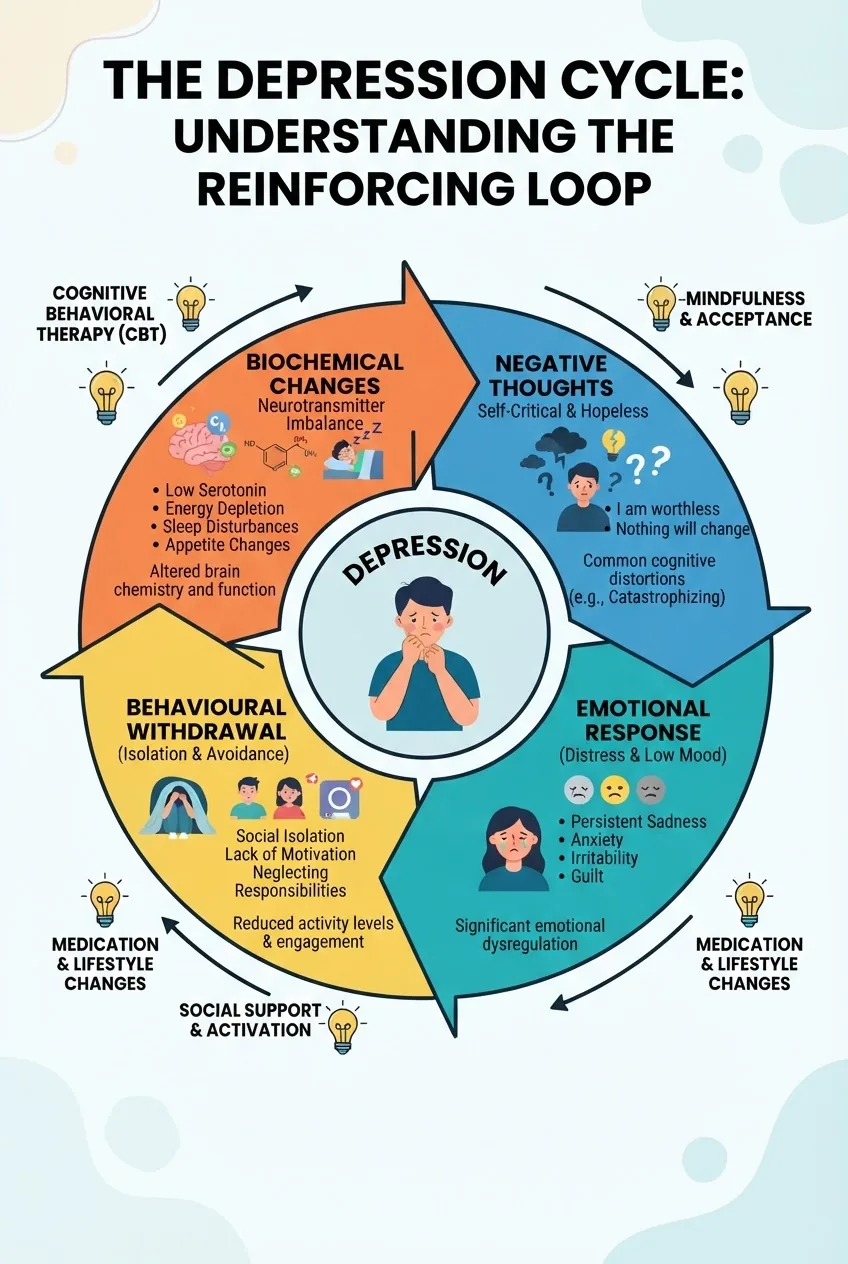
At a clinical level the loop has interacting layers:
- Cognitive layer: Negative thinking (catastrophising, overgeneralising) biases attention to threat and failure, diminishing motivation and hope. These cognitive distortions are learned response patterns that become automatic and self-validating.
- Emotional layer: Persistent sadness, irritability and anhedonia (loss of pleasure) reduce emotional regulation capacity and amplify reactivity to stress.
- Behavioural layer: Behavioural withdrawal limits exposure to positive experiences and social support; reduced activity lowers mood via loss of reinforcement and weakens problem-solving practice.
- Biological layer: Sleep disturbance, appetite change, altered cortisol rhythms and neuroinflammatory signaling shift brain circuits governing reward and stress, making negative cognitions stickier.
Cause-effect interactions often follow a predictable sequence: a stressor prompts negative interpretation (causal direction A→B); that interpretation leads to avoidance (B→C); avoidance reduces opportunities for corrective experiences, which strengthens the negative interpretation (C→A), closing the loop. This reinforcement loop is a core reason why depressive states persist beyond the initial trigger.
Neurobiological mechanisms underpinning persistence include maladaptive plasticity in cortico-limbic circuits, reduced reward responsiveness in the ventral striatum, and dysregulated stress response systems; for a technical review on mechanisms see the pathogenesis of depression.
Treatment-resistant depression exacerbates cycle perpetuation: repeated failed responses to standard treatments can increase hopelessness and entrenched avoidance, raising relapse risk and prolonging neurobiological dysregulation.
Key Components of the Depression Cycle
Answer: The depression cycle comprises interacting components—cognitive distortions, emotional dysregulation, social isolation/behavioural withdrawal, and biochemical contributors—which together sustain and worsen depressive states unless targeted for interruption.
Term: emotional dysregulation is difficulty managing or returning to baseline from strong emotions; biochemical contributors means neurochemical and hormonal changes that affect mood and energy.
- Cognitive distortions — automatic, biased thinking patterns (e.g., all-or-nothing thinking, catastrophising) that interpret events negatively and reduce adaptive coping. These distortions are targeted directly by CBT techniques. See atypical depression symptoms and treatment options for how patterns differ in some subtypes.
- Emotional response — persistent low mood, increased anxiety or blunted affect that limit cognitive flexibility and make behavioural activation harder.
- Behavioural withdrawal / social isolation — decreased activities and social contact remove positive reinforcement and reduce corrective feedback, worsening both mood and self-beliefs. For overlap with fatigue symptoms see distinguishing fatigue from depression.
- Biochemical contributors — sleep and circadian disruption, HPA-axis hyperactivity, neurotransmitter imbalances and inflammation that make cognitive and behavioural shifts less effective unless addressed.
- Contextual stressors — life events, ongoing interpersonal stress or socio-economic pressures that repeatedly trigger downward shifts and maintain the cycle.
- Treatment history and expectations — previous treatment failures can increase hopelessness and alter help-seeking behaviour, particularly relevant to treatment-resistant depression. For severe variant considerations see psychotic depression characteristics and treatments.
- Protective and resilience factors (inverse components) — social support, problem-solving skills and adaptive routines that, if strengthened, shorten episodes and reduce recurrence.
Clinicians assess which components dominate for each person to prioritise targeted interventions (e.g., prioritise sleep restoration if circadian disruption is central, or behavioural activation when withdrawal is the main maintaining factor).
Identifying Your Personal Depression Cycle
Answer: Identify your personal depression cycle by tracking moods, thoughts, behaviours and triggers over weeks; map early warning signs, common cognitive distortions and activity patterns to form a personalised cycle diagram that guides timely interventions.
Term: self-monitoring is the regular recording of symptoms and behaviours; mood tracking is logging emotional state over time to find patterns.
- Start a structured mood log: for 4–6 weeks record daily mood (0–10), sleep, activity, social contact and notable thoughts; use simple spreadsheets, apps or paper. Include a column for triggers and one for coping responses.
- Identify recurring patterns: after 2–3 weeks, highlight repeated antecedents (e.g., isolation after conflict) and consequences (e.g., more negative self-talk, longer sleep latency).
- Map cognitive distortions: note automatic thoughts tied to low-mood periods and mark common distortions (label them: catastrophising, discounting positives, mind-reading).
- Spot early warning signs: reduced interest, restless sleep, small social withdrawal, increased self-criticism—these are your personal red flags to act early.
- Create a one-page cycle diagram: link triggers → thoughts → feelings → behaviours → physiological responses; place two achievable early actions beside each link (e.g., call one friend, 10-minute walk).
- Use validated tools: standardized measures (PHQ-9, GAD-7) help quantify severity; discuss scores with a clinician if rising trends appear.
If you function well externally, watch for subtle signals: decreased concentration, missed commitments, or subtle avoidance—see high functioning depression symptoms for examples of subtle cycles.
Practical tip: keep a weekly “behavioural activation” checklist (three small achievable activities per day) and compare it with mood scores; improvement in activity often precedes mood improvement.
Strategies to Break the Vicious Cycle of Depression
Answer: Break the vicious cycle by combining behavioural activation, cognitive restructuring (CBT), mindfulness, sleep and lifestyle normalization, medication adherence when indicated, and stepped clinical care—these methods reduce negative reinforcement and restore neurobiological balance.
Term: behavioural activation is a structured approach to increase engagement in rewarding activities; CBT (cognitive behavioural therapy) is a psychotherapy targeting thoughts and behaviours.

Immediate, practical home-based steps (first 72 hours)
- Stabilise sleep-wake timing: go to bed and rise consistently, avoid long naps; light exposure in the morning resets circadian rhythms.
- Small graded activity plan: schedule 10–20 minute tasks (walk, phone call, meal prep) and mark them as completed; use a visible checklist.
- Limit rumination windows: set a 20-minute “worry period” and postpone problems outside that window to reduce unstructured negative thinking.
- Social contact goal: one brief social connection per day (message or 10-minute call) to counter isolation.
Evidence-based psychological methods
- Cognitive Behavioural Therapy (CBT): targets cognitive distortions with techniques like thought records, behavioural experiments and activity scheduling; CBT shows robust efficacy for reducing depressive relapse across trials. Use structured thought records to record automatic thoughts, evidence for/against and behavioural experiments to test beliefs.
- Behavioural Activation: focuses on reintroducing meaningful activity to increase reinforcement and improve mood; useful when withdrawal is primary.
- Mindfulness and MBCT (Mindfulness-Based Cognitive Therapy): helps reduce ruminative response styles and has evidence for relapse prevention in recurrent depression.
- Problem-solving therapy: practical steps to resolve solvable stressors that often trigger the cycle.
Biological and lifestyle interventions
- Prioritise sleep hygiene: consistent timing, limit screens before bed, brief morning light exposure and treat insomnia early with behavioural measures or CBT-I if needed.
- Exercise: graded, regular aerobic or resistance activity 3–4 times weekly has moderate antidepressant effects and restores reward processing.
- Nutrition and alcohol moderation: stabilise blood sugar with regular meals, limit alcohol as it worsens mood and sleep.
Medication and adherence
When indicated, standard antidepressants can reduce symptom severity and interrupt biological perpetuation of the cycle; adherence, dose optimisation and regular review are essential—see the dedicated resource Treatment for Treatment Resistant Depression: Medication and Therapy for in-depth medication strategies. Medication alone is often insufficient for breaking entrenched behavioural and cognitive patterns without concurrent psychotherapy.
Clinical steps for more entrenched cycles
- Stepped care: escalate from guided self-help and psychotherapy to combined pharmacotherapy and specialist options if minimal response after 6–8 weeks.
- Targeted psychosocial interventions: interpersonal therapy, schema therapy or adjunctive neurostimulation may be considered depending on history.
- Relapse prevention plan: create concrete steps tied to personal early-warning signs (contacts, medication plan, immediate therapy access).
Practical therapy exercises to disrupt patterns
- CBT thought record: note the situation → automatic thought → evidence for/against → alternative balanced thought → chosen action.
- Graded exposure/activity scheduling: start with tiny achievable steps (5–10 minutes) and scale up to rebuild confidence.
- Mindfulness practice: 10 minutes daily focused attention reduces rumination and improves emotion regulation.
Clinical evidence and prognosis
Randomised trials show CBT, behavioural activation and combined approaches reduce relapse rates; peer-reviewed systematic reviews in journals such as the Journal of Affective Disorders summarise this evidence. According to a 2024 industry report on relapse studies, combining psychotherapy with medication reduces recurrence risk more than either modality alone.
For readers asking about long-term outcomes, see can depression be cured? for an extended discussion on recovery, remission and functional recovery timelines. For specific treatment options, review major depressive disorder treatments.
Practical clinical note: if routine strategies produce limited change after a reasonable trial (4–8 weeks), escalate care—different mechanisms may be driving the cycle, especially in treatment-resistant depression.
Role of Medication and Therapy in Interrupting the Cycle
Answer: Medication and psychotherapy each reduce different drivers of the depression cycle—antidepressants address biological contributors, psychotherapy targets cognitive distortions and behavioural withdrawal—and combined approaches are often more effective, especially for treatment-resistant cases.
Term: antidepressants are medications that modulate neurotransmitters implicated in mood; psychotherapy denotes structured psychological treatments like CBT, interpersonal therapy or behavioural activation.
Clinical guidance from Australian health authorities recommends assessment, monitored pharmacotherapy when indicated, and evidence-based psychotherapy for moderate to severe cases; see the NSW and national mental health guidelines for service-level recommendations: NSW Health mental health guidelines.
| Intervention | Primary target | Role in breaking cycle |
|---|---|---|
| Antidepressant medication | Biological contributors | Improves sleep, mood reactivity; reduces biological barriers to psychotherapy |
| Cognitive Behavioural Therapy (CBT) | Cognitive distortions, behaviour | Teaches thought restructuring and behavioural activation to break reinforcement loops |
| Behavioural Activation | Behavioural withdrawal | Directly increases reinforcement and counters avoidance |
| Adjuncts (ECT, neurostimulation) | Severe treatment-resistant biology | Rapid symptom reduction in selected cases, enabling psychosocial work |
Australian clinical practice references and DSM-5 frameworks inform assessment and stepped-care decisions; for a full clinical pathway and medication algorithms, review Treatment for Treatment Resistant Depression: Medication and Therapy.
Clinical insight: in many patients medication reduces the biological inertia (sleep, appetite, concentration) so CBT or behavioural activation can be more effectively implemented; in treatment-resistant depression, multi-modal approaches and specialist review are often required.
When to Seek Professional Help: Avoiding Cycle Entrapment
Answer: Seek professional help when early warning signs escalate, daily function is impaired, self-help is insufficient after several weeks, or if there is crisis risk (suicidal thoughts), to avoid entrapment and enable timely, evidence-based interventions.
- Immediate crisis: any thoughts of harming yourself or others—contact emergency services or crisis lines right away.
- Escalating symptoms: worsening mood, persistent sleep/appetite disruption, marked withdrawal or increasing hopelessness—see a GP or psychologist.
- Poor response to self-help: minimal change after 4–8 weeks of consistent behavioural and psychological strategies suggests clinical review.
- History of severe episodes: past hospitalisation, psychotic features or suicidality—seek specialist psychiatric input and relapse prevention planning.
- Relapse prevention: if you’ve recovered before, create a plan with a clinician to act at first warning signs.
For service navigation in New South Wales, consult NSW Health mental health guidelines. Always prioritise safety: if unsure contact local urgent care resources or crisis lines immediately.
Maintaining Progress and Preventing Relapse
Answer: Maintain progress by consolidating coping skills, monitoring mood, sustaining social and activity routines, adhering to treatment plans, and building a relapse prevention strategy with clear actions at early warning signs.
Long-term strategies require both behavioural routines and proactive monitoring.
- Structured maintenance plan: weekly activity scheduling, monthly symptom review, and quarterly clinical check-ins.
- Skills consolidation: continue CBT exercises, thought records and mindfulness practices even when well.
- Support networks: regular contact with trusted people and peer-support groups reduces isolation.
- Medication review: follow clinician advice for continuation vs tapering; abrupt changes can precipitate relapse.
- Monitoring and early action: maintain a simple early-warning sign checklist and predetermined steps (contact clinician, increase therapy frequency).
Numbered checklist for weekly maintenance:
- Three planned meaningful activities this week
- Two brief social contacts
- Daily 10-minute mindfulness or exercise
- Weekly mood rating and PHQ-9 every month
- Immediate clinician contact if warning signs appear
For targeted relapse-prevention techniques in severe cases, review specialist guidance on severe depression relapse prevention.
Patient experience note: many patients find progress is non-linear; normalise temporary setbacks while using your relapse plan to prevent full recurrence.
Final takeaways: Recognise the depression cycle as an interacting system of thoughts, feelings, behaviours and biology; use monitoring, behavioural activation, targeted psychotherapy, and appropriate medication together to break the loop. Early identification and a written relapse-prevention plan improve outcomes—contact your GP or clinic to develop a personalised plan.
If you want help mapping your personal cycle or creating a relapse plan, contact a local clinician for assessment and a stepped-care approach tailored to your needs.